An Architect’s Role in Property Loss and Insurance Recovery, by D. Bradford Anderson, AIA

Our intention here is simply hitting a few key points “at a glance” that may be helpful for architects and design professionals when assisting with a client’s loss assessment.

Architects best understand building systems as a whole and any further detail as needed with his team.  Insurance adjusters and/or their consultants on the other hand usually look at a loss focused on their area of expertise.  For that reason, an architect’s overview on any large loss is best.

Years ago, we had designed and built several projects in Florida.  After multiple hurricanes, several of our previous clients had a difficult time with their property insurance recovery and requested our assistance.  “Property Loss and Insurance Recovery” is another whole world.  Never assume anything.

Some basic guiding principles regarding Property Loss

The Insurance Policy is simply a Contract between the Insurer and the Policyholder stipulating specific conditions, endorsements and exclusions and what the insurer will Pay for a Loss in exchange for a Premium (payment).

As clearly stated in the Policy:

After a Loss, Submit a “Notice of Loss” to the Insurance Company or Insurance Agent.

The Insured will receive a “Claim Number” for any future reference.

It is the “Duty of the Insured” to “Submit the Loss.”
“Do not” rely on the insurance adjuster to assess your loss.

Insurance companies rely on experts to protect their interests, it’s essential the insured do the same.
Insureds are entitled to use Industry Professionals (i.e. Architects, Engineers) as required.  Public Adjusters are licensed by each state to settle Insurance Claims and regulated by the State’s Banking and Insurance Divisions.  This is where architects can get further involved.

Architects can play a key role in the Recovery Process.  Understanding the coverages and policy provisions are both critical.  The design and building industries use various estimating and cost programs.  The Insurance Industry will typically their own estimating software, Xactimate being the most common.  Although the Xactimate format is quite different than that used in the building industry, costs can easily be compared line item by line item. 

We will make ourselves available to discuss further and answer any questions.

D. Bradford Anderson, AIA

561-385-0290 | dba@andrexus.com

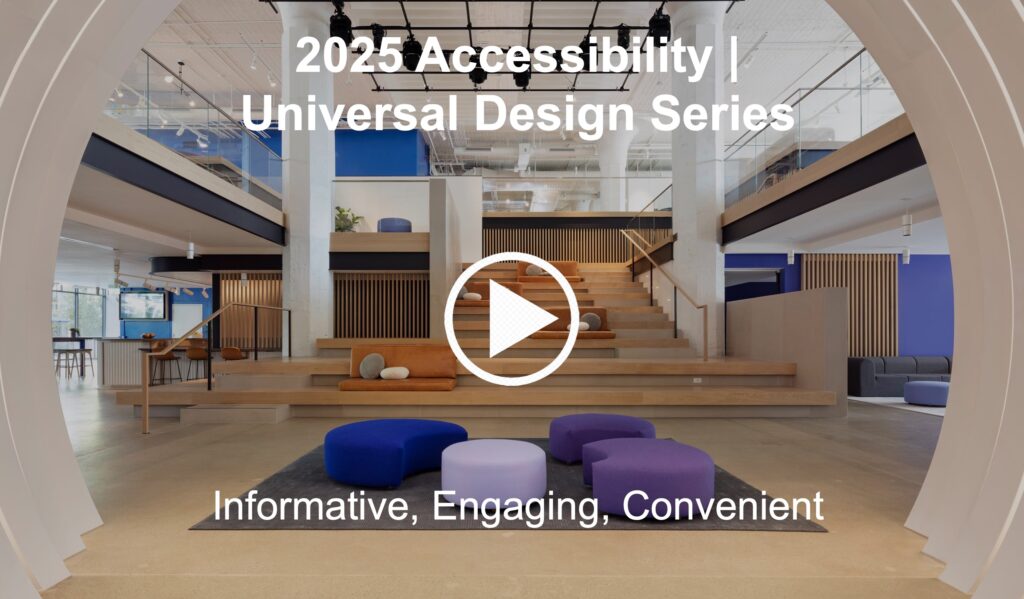
2025 Accessibility – NEW on-demand programs by AIA California

These programs can be taken individually, or bundled to ensure members obtain their full 5hr requirement. 

Center for the Deaf and Hard of Hearing Youth

(75 minutes, 1.25 AIA/HSW Units)

Mithun partners Brendan Connolly, AIA, LEED AP, and Dorothy Faris, ASLA, present the Center for Deaf and Hard of Hearing Youth in Vancouver, Washington, where designers and researchers translated DeafSpace design principles to create a welcoming, accessible and inclusive facility. They also explore how an exposed mass timber wood structure reinforced these principles and how the biophilic benefits of wood helped frame strategies for multisensory wayfinding in this extraordinary collection of gathering and teaching spaces.

Willie Woo Woo Wong Playground and Clubhouse Renovation

(75 minutes, 1.25 AIA/HSW Units)

This case study of the Willie Woo Woo Wong Playground and Clubhouse renovation in San Francisco’s Chinatown illustrates how to design an accessible and inclusive facility on a steeply sloping site. Scott Davis, AIA, of Jensen Architects and Willett Moss, PLA, FAAR, FASLA, of CMG Landscape Architecture discuss Universal Design features, accessible paths of travel, exterior transfer stations, interior lifts, companion seating and access to equivalent spaces. They also discuss how the City and County of San Francisco’s accessibility requirements influenced the renovation of one of San Francisco’s historic and culturally significant recreational facilities.

Accessibility, Historic Preservation + Adaptive Reuse

(60 minutes, 1.0 AIA/HSW Units)

D. Rocky Rockefeller, AIA, of Rockefeller Partners Architects presents this fascinating case study of converting the historic Ford Motor Company Factory in Los Angeles into an award-winning creative office space for Warner Music Group. Rocky deftly describes how to preserve a building’s historic fabric while navigating the requirements of the State Historical Building Code and California’s stringent accessibility requirements.

UC Berkeley: Equitable Campus Planning, Universal Design

(90 minutes, 1.5 AIA/HSW Units)

Learn about accessibility and Universal Design solutions at the University of California, Berkeley campus. UC Berkeley’s Campus Architect and its Manager of Physical Access Compliance and principals from Leddy Maytum Stacy Architects and Sasaki Associates discuss how the campus developed and implemented a human-centered approach to provide equitable physical access to buildings and amenities throughout a hilly site.

AIA continuing education

Architecture Week ’25 at Girls Academic Leadership Academy

Architecture Week ’25 at Girls Academic Leadership Academy

The American Institute of Architects is committed to inspiring K-12 students who will meet the future needs of an ever-evolving profession. Starting early is the key, and Architecture Week is ideal timing to highlight the benefits of pursuing Architecture as a viable career path.

Architecture Week serves to:

  • Inspire youth to learn about the power of design.
  • Nourish curiosity to engage in solving grand challenges with design.
  • Connect students with architects and design professionals.

AIA Long Beach / South Bay was awarded a grant from the AIA to provide Architecturally focused education to the Architectural Design pathway at Girls Academic Leadership Academy (GALA), the only all-girls public STEM school in the state of California and part of Los Angeles Unified School District (LAUSD).

We would like to thank our speakers, Jenny Delgado, AIA, Principal & Education Practice Leader, Cannon Design, Hiba Brewster, Senior Designer, Studio One Eleven, Surabhi Khanderia, AIA, Senior Design Manager with Leading Edge Consulting Services, Heidi Creighton, FAIA, LEED Fellow, Senior Design Manager, City of Santa Monica Architectural Services Division, Carlos Hernandez, AIA, Sr. Associate/ Director of Technical Management at RDC-S111, and AIA LBSB Executive Director, Kristine Hammond. Collectively, we connected with approximately 100 students across four classrooms over three days.

Arch Week 2025 results